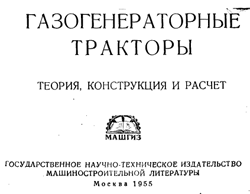
 Yudushkin — Gas-Generator Tractors: Theory, Design, and Calculation
The book *Gas-Generator Tractors: Theory, Design, and Calculation* by Yudushkin outlines the fundamental theories of fuel gasification, gas cleaning in tractor gas-generator systems, and the combustion of producer gas in modern tractor engines.
In addition, the book provides a description of the design of gas-generator systems.
*Gas-Generator Tractors: Theory, Design, and Calculation* is intended for engineers working in the field of tractor gas-generator manufacturing.
Advances in the theory of fuel gasification, gas cleaning, and combustion processes—combined with extensive practical experience gained in the design, production, and operation of tractor gas-generator systems in our country—have recently led to the development of gas-generator tractor models that rival liquid-fuel tractors in terms of productivity and service life.
This book covers the theoretical foundations of modern views held by leading Soviet science regarding fuel gasification and gas cleaning; it also presents calculations for determining gas composition and selecting the key dimensions of gas-generator system components. Furthermore, the book describes the designs of widely used gas-generator tractors.
The sections “Fuel for Tractor Gas Generators” and “Converting Tractor Engines to Producer Gas” were written by Candidate of Technical Sciences M. D. Artamonov, while the remaining sections were authored by engineer N. G. Yudushkin.
The ever-growing fleet of tractors and automobiles consumes vast quantities of liquid fuel. Since oil extraction and refining are concentrated in only a few regions of the country, long-distance transport is required to supply fuel to other areas. Therefore, the use of local fuels is of great importance to the national economy.
The process of converting solid fuel into a gas—which burns when mixed with air in an internal combustion engine, releasing thermal energy that is then transformed into mechanical energy—can be carried out in specialized units known as gas generators. Various types of solid fuel can be used in these generators.
In agriculture, the use of a variety of local fuels—such as wood, peat briquettes, semi-coke (a product of coal processing), anthracite, and others—in gas-generator tractors is of great importance.
Gas-generator vehicles and tractors running on wood gas became widely used in the forestry industry.
Gas-generator systems were initially adopted primarily for automobiles. However, the subsequent development of gas-generator designs for both tractors and automobiles proceeded in parallel.
The first experimental gas-generator vehicle designs appeared between 1923 and 1928.
Prof. V. S. Naumov, Prof. V. P. Karpov, and the inventor S. I. Dekalenkov made significant contributions to the development of gas-generator vehicle and tractor designs.
In subsequent years, the production of gas-generator vehicles and tractors was assigned to the automotive and tractor industry. The automotive and tractor industry, along with NATI, developed a range of gas-generator designs for tractors and vehicles.
The organization of endurance runs for GAZ-42 and ZIS-21 gas-generator vehicles between 1934 and 1938—as well as comparative tests of various gas-generator systems on tractors in the forestry industry (1935–1939) and agriculture (1936–1938)—helped refine the designs of gas-generator tractors and vehicles and popularized the concept of using solid fuel to power the vehicle and tractor fleet.
In recent years, the production of KT-12 gas-generator skidder tractors was established at the Leningrad Kirov Plant. The gas-generator system on this tractor shares a common layout and several standardized components with the system used on the KhTZ-T2G tractor.
Production of the KT-12 tractor was subsequently transferred to the Minsk Tractor Plant.
In 1952, production of the new GB-58 gas-generator tractor—based on the diesel-powered DT-54 tractor—was launched. This tractor features increased engine power and easier starting on gas; a fan is used to ignite the fuel in the gasifier, high-temperature components are designed to be replaceable, and gas purification has been improved. The service life of the gasification chamber has been extended to 2,000 hours.
The GB-58 tractor operates with the same set of agricultural implements as the DT-54 and approaches it in terms of productivity.
Recently, the range of fuels used in gas-generator tractors has been expanded. For instance, the GB-58 gasifier can process peat briquettes in addition to wood fuel. A major challenge—the gasification of moist fuels—has been addressed by removing excess moisture from the gasifier hopper. Improvements to the gas purification system include not only redesigned centrifugal cleaners but also the introduction of new filter types with increased interfacial contact area and mechanically driven gas scrubbers.
Download – Yudushkin — Gas-Generator Tractors: Theory, Design, and Calculation >>