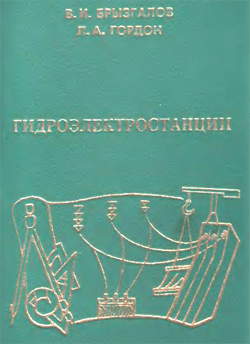
 Bryzgalov – Hydroelectric Power Stations
Bryzgalov’s book, “Hydroelectric Power Plants,” provides basic information on the structures and equipment of hydroelectric power plants. It covers issues of hydroelectric power generation, its economic efficiency, and social significance.
Bryzgalov’s book, “Hydroelectric Power Plants,” is intended for students studying hydroelectric engineering and electric power engineering.
Hydroelectric power plants and pumped-storage power plants (HPPs and PSPPs) continue to occupy a particularly important place in modern energy systems, playing a key role in regulating their parameters in non-stationary conditions and covering the most uneven portion of load curves. Furthermore, the low cost of commercial output from hydroelectric power plants has a very positive impact on electricity pricing in the sales market.
Hydroelectric power plants are complex natural and technical systems. Their design, construction, and operation require familiarity with a wide range of general and specialized technical disciplines.
Due to the aging of fixed assets, both hydroelectric power plants and the electric grid, as well as the natural attrition of operating personnel, problems will arise in ensuring the reliability and safety of hydroelectric power plants and electric grids unless new capacity is commissioned and young specialists are trained.
Under market conditions, requirements for reducing operating costs for production facilities are becoming increasingly stringent. In particular, this means minimizing the number of maintenance personnel at electric power facilities. This means that the challenge of combining the skills of specialists working in the design, construction, and operation of hydroelectric power plants and electric grids is becoming more pressing. Moreover, at aging hydroelectric power plants, there is a need not only for the reconstruction of the main hydroelectric and electrical equipment but also for major repairs of hydraulic structures (HS), meaning specialists must have knowledge of construction and installation work even at operating hydroelectric power plants.
These circumstances are compounded by the market situation with fossil fuel supplies for thermal power plants (TPPs), the cost of which will continue to rise and reserves will deplete. Therefore, renewable energy—river energy—will increasingly attract attention when planning capacity expansion in energy systems through the construction of hydroelectric power plants. Initially, preference will be given to the construction of small and medium-sized hydroelectric power plants, followed by large hydroelectric power plants. Production economics, particularly in the construction of small and medium-sized hydroelectric power plants, will also dictate the need to minimize personnel by combining the skills of specialists in hydroelectric power plant construction, equipment installation, and commissioning.
The integrated specialty of “Hydroelectric Power Plants” involves combining specialists from three fields: a hydropower engineer/hydraulic engineer (water energy utilization and construction of structures); a mechanical engineer, a specialist in turbine and hydromechanical equipment for hydroelectric power plants; and an electrical engineer, a specialist in electrical equipment, relay protection, and automation.
Bryzgalov’s book “Hydroelectric Power Plants” is a textbook for the specialized course “Hydroelectric Power Plants” for students majoring in the same specialty.
In each of the three listed areas, students will take a series of basic and specialized courses, covering specific areas of their future profession. The goal of this specialized course is to tie together the main aspects of the specialty, integrate and outline the role of each of the individual disciplines studied, and thereby provide a general framework for the future profession.
A young specialist who has obtained this specialty will also be able to successfully work in the design, construction, and operation of power transmission lines, as well as grid substations.
This textbook was developed based on many years of experience in the design, construction, and operation of major hydroelectric power plants: the Volga Hydroelectric Power Plant (Zhigulevsk), the Krasnoyarsk Hydroelectric Power Plant, and the Sayano-Shushenskaya Hydroelectric Power Plant, where one of the authors participated in their construction and operation, and the other was part of the team of experts assessing the stress-strain state of the Sayano-Shushenskaya Hydroelectric Power Plant dam.