

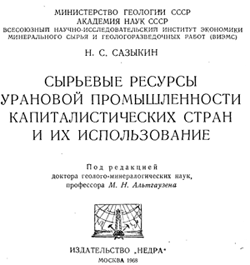
 Sazykin – Raw materials of the uranium industry of countries
Sazykin’s book, “Raw Materials of the Uranium Industry of Countries,” contains the latest data on the mineral resources of the uranium industry in capitalist countries. It examines uranium reserves across the capitalist world as a whole, and within it, by continent and country. It provides a geological and economic assessment of industrial deposits, as well as potential mineral resources for the uranium industry. For the first time in literature, and specifically in Sazykin’s book, “Raw Materials of the Uranium Industry of Countries,” an attempt has been made to study the economic efficiency of geological work in capitalist countries and determine the specific costs of geological work in the cost of finished products (uranium concentrates). The volume of uranium ore production and processing methods are characterized, and the technical and economic indicators of uranium ore mining and processing are also examined. The dynamics of uranium concentrate production over the past 10 years (1956–1966) and the utilization of production capacity at mines and hydrometallurgical plants are analyzed, along with the sizes of existing and planned uranium enterprises. The structure of uranium raw material consumption and the prospects for uranium use for military and peaceful purposes are determined. The international trade in uranium raw materials is characterized: an analysis of the global market for uranium concentrates in the post-war years is provided, as well as the dynamics of uranium concentrate exports and imports in the capitalist world and in individual capitalist and developing countries, as well as prices and pricing for uranium raw materials, price dynamics, production costs, and profits.
Over the past 25 years, it is difficult to find another mineral resource for which the struggle between leading capitalist countries has been so fierce and intense. This struggle flared up during World War II, when the United States, exploiting its economic and military superiority over other capitalist countries, through various international agreements with England, Canada, and Belgium, brought under its control almost all of the then-largest uranium ore deposits, mining, and processing plants (Eldorado in Canada and Shinkolobwe in the Congo). Establishing American control over Canadian and Congolese uranium meant the de facto subordination of all uranium resources in capitalist countries to the United States. The presence of uranium deposits in Nazi Germany and the European states it occupied did not raise serious concerns at the time, as the Germans were far from having a practical solution to the problems associated with the production of atomic weapons.
The scramble for uranium intensified after World War II due to the arms race. The United States, emerging from the war stronger than other capitalist countries, continued to seize ever more uranium sources. None of the imperialist powers could resist American imperialism with the same strength, as Britain and France were sharply weakened during the war, although they remained major colonial powers for some time, while Germany, Japan, and Italy were defeated.
Under these circumstances, the CITA expanded its control over uranium sources and production in Canada and the Congo (with its capital in Kinshasa), and also partially controlled the use of uranium mined in South Africa, Australia, Spain, and Portugal.
The establishment of a state monopoly on nuclear weapons production in the United States and the large public funds provided to private companies in the form of loans and subsidies
enabled the latter to conduct extensive geological exploration not only in the United States but also in other countries. This led to the discovery of several large industrial uranium deposits in the United States, Canada, and South Africa within a relatively short time. By 1966, these countries accounted for 79.3% of the identified industrial uranium reserves in capitalist countries and 86.6% of its production.
The US government, and the Atomic Energy Commission, under its authority, entered into a series of agreements committing to purchase uranium concentrates at high government prices over a long period of time, which laid the foundation for the rapid development of a large-scale uranium industry.
In the early postwar years, the US purchased all the uranium mined in capitalist countries. Subsequently, with the establishment of atomic weapons production in England and France, a relatively small portion of the uranium began to be used in these countries as well.
By 1966, the following situation had emerged: The United States held 25.2% of the identified industrial uranium reserves of capitalist countries and 50.7% of concentrate production.
According to published data, England has no industrial uranium ore reserves within its borders. However, it obtains them from countries within the British Commonwealth, which hold 60% of the industrial uranium reserves of capitalist countries. England consumes approximately 7-10% of all uranium produced by capitalist countries.
France, striving to pursue an independent policy in the field of atomic weapons production, is attempting to establish its own mineral resource base for the uranium industry within its own territory and in its former colonies, where the influence of French monopolies still lingers. France succeeded in discovering a number of promising deposits on its territory, as well as in the Gabonese and Malagasy Republics, and in organizing the extraction and processing of uranium ores. In 1966, French monopolies controlled 7.3% of the industrial uranium reserves of capitalist countries, of which 6.0% were within their own country. Taking into account the production of uranium concentrates in some African countries that continue to be economically dependent on France, French monopolies in 1966 controlled 10.9% of the production of this type of raw material in capitalist countries.
Download – Sazykin – Raw materials of the uranium industry of countries>>