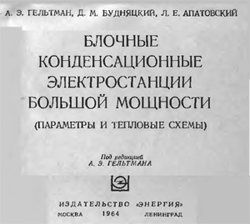
 Geltman, Budnyatsky – Large-capacity block condensing power plants
The book by Geltman and Budnyatsky, “Large-Capacity Modular Condensing Power Plants,” addresses issues related to the selection of key parameters and characteristics of the primary thermal-mechanical equipment of large-capacity modular condensing power plants (CPPs), including unit capacities, initial and final steam parameters, and thermal circuit parameters and characteristics.
Geltman and Budnyatsky’s book, “Large-Capacity Modular Condensing Power Plants,” provides a methodology for technical and economic calculations in this area.
Along with thermodynamic dependencies, the book presents the initial data and results of a technique for economic optimization of the main unit parameters.
Geltman and Budnyatsky’s book, “Large-Capacity Modular Condensing Power Plants,” is intended for employees of planning, design, engineering, and research organizations in the fields of energy and nuclear engineering. It can also be used as a textbook for students majoring in energy at higher education institutions.
Improving the standard of living and well-being of the Soviet people is inextricably linked to the successful implementation of Lenin’s vision of the country’s total electrification.
Electrification determines the level of energy available to labor, and consequently the degree of mechanization and automation of production. This determines its leading role in the development of all sectors of the national economy and the need for accelerated growth rates in electricity generation.
By 1962, electricity generation had already reached 369 billion kWh, and the installed capacity of power plants was 83 million kWh.
By the end of the current seven-year plan (by 1965), annual electricity generation should exceed 520 billion kWh. To achieve this, thermal power plants will need to commission a capacity of 47-50 million kWh by 1965, primarily through new equipment with modular designs. During this period, widespread deployment of 150 and 200 MW units operating at 130 ata and 565/565°C will continue, as will 17 300 MW units operating at 240 ata and 560/565°C. By the end of the seven-year plan, prototype units of higher capacity—500 and 800 MW units operating at 240 ata and 560-580°C with intermediate superheat up to 565°C—should also be in production.
The long-term goals for the country’s electrification, set out in the new Party Program adopted at the congress, call for a nearly threefold increase in the energy intensity of labor over the next ten years, as well as the substantial completion of the country’s electrification. Annual electricity production should be increased to approximately 900-1,000 billion kWh by 1970, and to 2,700-3,000 billion kWh by the end of the second decade (by 1980).
To ensure such an increase in electricity generation, the total capacity of power plants must increase to 540-600 million kWh by the specified date.
Due to the enormous increase in the scale of new energy construction, the importance of upgrading power plants and improving the technical and economic indicators of electricity generation is significantly increasing. The economic impact that can be achieved by addressing the scientific and technical challenges facing the energy sector is illustrated by the fact that just a 1% reduction in the cost of energy construction, planned for a 20-year period, saves the national economy 1 billion rubles, while a 1% increase in energy equipment efficiency could result in an increase in energy production of 250 billion kWh over this period, or fuel savings at thermal power plants of approximately 65 million tons.
Fossil-fueled thermal power plants, which will generate approximately 80% of all consumed electricity, will play a decisive role in energy development over the 20-year period.
Over the next 20 years, approximately 200 district thermal power plants, each with a capacity of up to 3 million kWh, and 260 large combined heat and power plants are to be built. At the same time, approximately 70-75% of all electricity generated by thermal power plants will come from condensing power plants, which will play a leading role in the development of domestic energy production. Therefore, it is natural that particularly close attention should be paid to improving condensing power plants.
Improving the performance of condensing steam turbine power plants is currently primarily associated with increasing the unit capacity, increasing initial steam parameters, and improving thermal circuits (introducing intermediate superheats, developing regenerative feedwater heating), etc.
Favorable conditions for progress in these areas include the rapid development of energy systems and their integration (in the current seven-year plan, the creation of unified energy systems in the European part and Siberia, and subsequently the Unified Energy System), the continuous development of power engineering and metallurgy, and the improvement of overall power plant design solutions.
Further improvement of steam turbine units is possible by combining steam and gas working cycles. However, combined-cycle power plants of this type require the use of gaseous or liquid fuels. According to the development of the future fuel balance, over the next 15-20 years, most energy will be generated using solid fuels, or at least in power plants where gas or liquid fuel combustion will be only occasional. This limits the use of gas cycles, both in gas turbine units and in combination with the steam cycle, and necessitates the emphasis on improving…
Download – Geltman, Budnyatsky – Large-capacity block condensing power plants >>