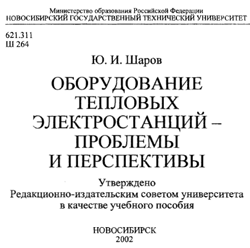
 Sharov – Thermal Power Plant Equipment – Problems and Prospects. Study Guide
Sharov’s book, “Thermal Power Plant Equipment – Problems and Prospects,” examines development trends in the global thermal power industry. It presents schemes for the use of natural and synthetic fuels. Environmental issues are also addressed.
Electricity at thermal power plants (TPPs) is generated using traditional fuels (coal, gas, fuel oil, peat, and oil shale) using powerful steam turbines that drive electric generators. Based on the specifics of their technological process, TPPs are divided into two types.
Condenser-type plants (CPPs), in which the exhaust steam passing through the turbine is cooled, condensed, and returned to the boiler. Drawn to fuel sources and regions with the highest electricity consumption, they are widespread throughout the world.
Combined heat and power plants (CHPs), a distinctive feature of which is that the steam or hot water processed in the turbine is then used for heating and hot water supply in industrial and municipal sectors. Combined heat and power plants (CHPs) are primarily built in large cities, as efficient steam or hot water transmission is only possible over distances of 20-25 km due to high heat losses in pipes. Furthermore, to reduce heat loss, CHPs must be supplemented by small substations located close to the consumer.
Despite all the aforementioned disadvantages, CHPs are combined heat and power plants, which increases the overall fuel efficiency to 70%, compared to the typical 30-35% for combined heat and power plants (CHPs). However, the maximum capacity of CHPs is typically lower than that of combined heat and power plants (CHPs).
The advantages of thermal power plants over other types of power plants are as follows:
- 1. Their relatively flexible territorial placement, due to the widespread availability of fuel resources.
- 2. Their ability (unlike hydroelectric power plants) to generate electricity without seasonal fluctuations in power output.
- 3. The land area required for the construction and operation of thermal power plants is typically significantly smaller than that required for nuclear power plants, let alone hydroelectric power plants.
- 4. Due to the widespread adoption of construction technologies, thermal power plants are constructed much faster than hydroelectric or nuclear power plants, and their cost per unit of installed electrical capacity is significantly lower than that of nuclear and hydroelectric power plants.
At the same time, thermal power plants also have significant, and in most cases, irreparable, disadvantages.
- 1. Operating a thermal power plant typically requires significantly more personnel than hydroelectric or nuclear power plants of comparable capacity, due to the need to service a very large fuel cycle.
- 2. Hydroelectric power plants are constantly dependent on supplies of non-renewable (and often imported) fuel resources (coal, fuel oil, gas, and, less commonly, peat and oil shale).
- 3. Thermal power plants are highly sensitive to repeated startups and shutdowns; changes in their operating mode dramatically reduce efficiency, increase fuel consumption, and lead to increased wear and tear on key equipment.
- 4. Thermal power plants are characterized by relatively low efficiency (typically up to 40%).
- 5. Thermal power plants have a direct and extremely adverse impact on the environment and are the dirtiest sources of electricity. Coal-fired power plants, especially high-ash coal-fired power plants, cause the greatest environmental damage to surrounding regions. Among thermal power plants, those using natural gas in their process are the most environmentally friendly.
Experts estimate that thermal power plants worldwide annually emit approximately 200-250 million tons of ash, over 60 million tons of sulfur dioxide, and large quantities of carbon dioxide (which causes the so-called greenhouse effect and leads to long-term global climate change), while absorbing enormous amounts of oxygen. Furthermore, it has now been established that excess radiation around coal-fired thermal power plants…
Download – Sharov – Thermal Power Plant Equipment – Problems and Prospects. Study Guide>>