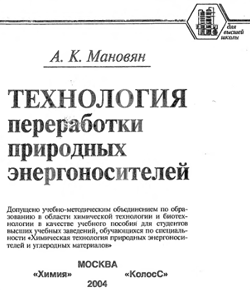
 Manokyan – Technology of processing natural energy resources
The three main types of non-renewable energy sources—natural hydrocarbon gases, liquid oils, and solid organic matter, including natural oil bitumen, oil shale, and coal—are examined in all their fundamental aspects, including their resources, production, processing, properties, and applications. The properties of the products of these processes—fuels, oils, and specialty products—are described.
Manokyan’s book, “Natural Energy Resource Processing Technology,” is intended for students of chemical engineering universities and postgraduate students—future specialists in the field of natural energy processing—as well as for scientists, engineers, and technicians working in this field.
Throughout human history, the concepts of “human” and “energy” have been inseparable. Since humans learned to make fire, the conscious use of various forms of energy has begun, and this process continues to this day.
Without dwelling on renewable energy sources (solar energy, the energy of moving air and water masses, nuclear energy, etc.), whose share in the overall energy balance is still small, let’s consider three main non-renewable energy sources: natural hydrocarbon gases, liquid oils, and solid organic matter, which include natural petroleum bitumen, oil shale, and coal.
The figure shows the change in the share of various energy sources in total energy consumption over a 200-year period, based on one forecast made in the early 1980s. At that time, it was assumed that coal consumption peaked in the 1970s, oil consumption in the 1980s, and gas in the 1990s. It is now clear that these forecasts have not entirely come true. Gas production is still expected to be at its peak. Oil consumption in the overall energy balance, although it has fallen, has not fallen as sharply as predicted. The same applies to coal. Therefore, if we adjust the shares of each energy source (points a, b, c) to 2000, the dynamics will be somewhat different.
Based on this, we know that the three main types of non-renewable energy sources—gas, oil, and coal—continue to play a decisive role in the energy balance, and therefore, questions about their processing technologies remain relevant.
Raw natural energy sources extracted from the earth, after purification and preliminary preparation, are processed primarily into fuels (85-90%), as well as oils and specialty products.
All of these sources play an extremely important role in the economy of every country, as the energy they provide is the foundation of industry, agriculture, all forms of transportation, and human life. It is impossible to imagine modern life without energy sources. The slightest disruption in the energy supply leads to serious consequences. A clear example is the energy crisis that shook America in 1973, when the entire country realized the importance of fuel resources. This is especially true for liquid petroleum fuels, without which modern industry and the population cannot function (and in aviation, they are absolutely indispensable).
Currently, all countries closely monitor the state of various energy resources and their consumption in order to identify prospects and forecast energy consumption in a timely manner.
Manokyan’s book, “Technology of Processing Natural Energy Resources,” consistently addresses the following issues.
Chapter 1 of Manokyan’s book, “Technology of Processing Natural Energy Resources,” describes the resources and production of energy resources (natural gases, oil, and coal), as well as the general scheme of their processing; the main consumers of fuels, particularly motor fuels; and the prospects for the development of motor manufacturing.
Chapter 2 of Manokyan’s book, “Technology of Processing Natural Energy Resources,” presents the properties of fuels and other products obtained from gases, oil, and coal, and explains their chemotological significance.
Chapter 3 of Manokyan’s book, “Technology of Processing Natural Energy Resources,” describes the processes for producing fuels from gases—both primary (natural and industrial) and secondary (industrial).
Chapter 4 of Manokyan’s book, “Natural Energy Resources Processing Technology,” is devoted to the processes of obtaining fuels, oils, and their components from crude oil. It describes and analyzes key processes, such as primary distillation, catalytic cracking and reforming, thermal destruction and hydrogenation processes, including hydrogen production, as well as the combination of technological processes and the production of commercial fuels.
Finally, Chapter 5 of Manokyan’s book, “Natural Energy Resources Processing Technology,” addresses the problems of processing natural petroleum bitumens and coal liquefaction.
Download – Manokyan – Technology of processing natural energy resources>>