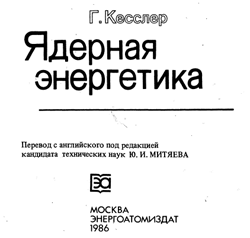
 Kessler – Nuclear Energy
Kessler’s book, “Nuclear Energy,” addresses the fundamental issues of modern nuclear energy: potential applications of nuclear energy sources, fuel supply, types and features of nuclear reactors, technical aspects of the main fuel cycle components, including spent fuel reprocessing, radioactive waste management, nuclear energy safety, and environmental impact.
Kessler’s book, “Nuclear Energy,” is intended for engineers, graduate students, and undergraduates.
The significant attention paid to the development of nuclear energy in our country, particularly in the European part of the USSR, is well known. Several large nuclear power plants, each with a capacity of 4 million kW, are already operating there, while existing ones are being expanded and new ones are being built. Our country operates half of the world’s operating fast neutron power reactors, which represent the future of nuclear energy, and is building the world’s first nuclear power plants and combined heat and power plants. In 1985, the world’s largest RBMK power reactor, with a capacity of 1.5 million kW (el.), was brought up to design parameters at the Ignalina Nuclear Power Plant. The achievements of the nuclear icebreaker fleet, which ensures virtually year-round navigation along the Northern Sea Route, are well known. The role and development of nuclear energy in the USSR is evidenced by the fact that nuclear power plants currently account for the bulk of the country’s electricity production growth. The role of nuclear energy will continue to grow, while the scope of nuclear energy applications expands.
This is convincingly demonstrated by the “Main Directions of Economic and Social Development for 1986-1990 and for the Period up to 2000.” Thus, during the 12th Five-Year Plan, along with a number of powerful nuclear power plants, nuclear combined heat and power plants near Odessa and Minsk, the Gorky and Voronezh nuclear power plants will be commissioned, and construction of new nuclear power plants with fast neutron reactors will begin. In 1990, nuclear power plants are planned to generate up to 390 billion kWh, i.e., 20% of all electricity generated in our country that year. This will ensure fossil fuel savings of 75-90 million tons of standard fuel. New types of nuclear-powered vessels will be added to the Soviet Union’s navy.
Domestic nuclear power plants and the power reactors installed at them have been examined in considerable detail in the scientific and technical literature. Many publications are devoted to the construction and operating experience of nuclear power plants, as well as to their installation and Equipment setup, the economics of nuclear energy, and its impact on the environment. Books and manuals are published on the design of power reactors and their individual systems, supported by publications on the theory and methods of reactor calculations, their monitoring and control, and other issues related to the use and production of energy through the fission of heavy nuclei.
It cannot be said that little attention is paid to the translation of foreign books and monographs on nuclear energy. However, most of these books are devoted to relatively narrow topics and do not provide an overview of foreign nuclear energy as a whole. In the domestic literature, there is also virtually no book that fully examines various foreign power reactors and covers all aspects and problems associated with the widespread introduction of nuclear energy.
It is hoped that the proposed translation of Kessler – Nuclear Energy is intended to fill this gap. At the very least, it will be a good addition to the domestic technical literature on nuclear energy in the Soviet Union – a supplement that sufficiently and comprehensively covers various areas of energy The book examines the problems and industries associated with the development of nuclear energy.
Kessler – Nuclear Energy was written by Professor G. Kessler, Director of the Institute of Neutron Physics and Reactor Technology at the Karlsruhe Nuclear Research Center (FRG). The author has 20 years of experience in various areas of nuclear energy. He participated in the work of the International Nuclear Fuel Cycle Review (INFCR), many of whose results he used in writing the book. A distinctive feature and advantage of the book is its comprehensive and in-depth examination of the main aspects of nuclear energy.
Along with the design and characteristics of various types of thermal and fast power reactors, it presents data on the current state of nuclear energy, discusses various forecasts for its development and long-term nuclear fuel supply. Much attention is paid to nuclear fuel cycles, from methods of uranium extraction, enrichment, and fuel rod production to the technology of reprocessing irradiated fuel and reliable disposal. radioactive waste. The risks and radiation impacts of nuclear power on the environment are examined in detail, and requirements for ensuring the safety of nuclear power plants are formulated. The book by G.K.
Kessler’s book summarizes international experience, scientific, and technical knowledge in various areas of nuclear energy. It reflects, to varying degrees, all significant innovations and improvements in nuclear energy.
Kessler’s book, Nuclear Energy, is written in simple, accessible language and requires no special training to understand. This makes it useful for a wide range of readers: technicians, students, engineers, and executives in nuclear energy and the nuclear industry. Specialists in specialized fields can also gain insight into the state of affairs and challenges in related fields.