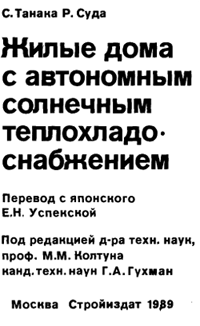
 Tanaka, Suda — Residential Buildings with Autonomous Heating and Cooling Systems (edited by Koltun; translated from Japanese by Uspenskaya)
The book *Residential Buildings with Autonomous Heating and Cooling Systems* by Tanaka and Suda (edited by Koltun, translated from Japanese by Uspenskaya) addresses a crucial issue: the cost-effective use of solar energy for the heating and cooling of residential buildings. It presents technical solutions for various heating and cooling systems implemented in the construction of both single-family homes and multi-apartment buildings.
This book is intended for researchers and engineering professionals.
The concept of the “solar house”—a home where heating, cooling, and hot water supply rely on solar energy—has become widely known today, not only among architects and HVAC specialists but also among professionals in many other fields. It is gratifying to see the idea of utilizing solar energy so favorably received and to witness the high expectations placed on its practical implementation. This aligns perfectly with the human desire to create a healthy natural environment, where solar radiation plays a significant role in conserving fuel and preventing environmental pollution.
There are still relatively few true solar houses featuring fully perfected heating and cooling systems, and making them economically viable is no simple task. However, it is evident that the Earth’s natural reserves of oil and coal will not last indefinitely and that future technological progress is inextricably linked to the need for energy conservation; thus, residential buildings will undoubtedly increasingly take on the characteristics of solar houses. It is no coincidence that the current discussion focuses not merely on using solar energy in future installations, but on a gradual transition from the limited practical application of solar systems to their widespread adoption. The concept of converting solar energy into heat has emerged twice before in Japan—each time with considerable intensity, much like the current surge of interest—first immediately after World War II and again in the 1960s. On both occasions, the idea was hindered by the immaturity of the engineering solutions available at the time. Furthermore, since curbing environmental pollution was not yet a pressing concern, the availability of cheap fuels relegated the issue of solar energy utilization to the background, causing interest in it to wane.
Currently, approximately 500,000 solar water heaters are sold annually in Japan, and about 100,000 hot water systems—featuring either forced or natural water circulation—are installed each year. It can be said that the foundation for a solar technology industry is already being laid. Significant progress has been made—surpassing previous efforts—in the development of key components (such as collectors and cooling units for solar-powered heating and cooling systems) and in the creation of design and technical solutions for solar technology. We can expect a transition to a new phase of widespread implementation to occur right now.
When discussing solar houses and solar energy systems, it is important to note that systems for hot water, heating, and combined heating and cooling vary significantly in terms of both technical sophistication and cost-efficiency. It is hardly surprising that the same type of hot water or heating system can differ in cost-efficiency by a factor of two or three, depending on the quality of its individual components and the specific design implementation. Manufacturers of solar systems often highlight only the advantages, while consumers and designers typically select systems almost at random. Overall, however, their implementation is proceeding with a view toward rapid adoption.
We believe that at this stage, it is crucial to clarify the capabilities and limitations of these systems and to synthesize all available information.
There is a substantial body of technical literature—including reference materials—dedicated to solar houses and solar energy systems. However, there are very few works that explain the issues of solar technology in accessible terms for non-specialists while accurately reflecting the actual state of the field for professionals.
This book, *Residential Houses with Autonomous Heating and Cooling Systems* by Tanaka and Suda (edited by Koltun; translated from Japanese by Uspenskaya), aims to explain—in an accessible manner—the technical issues associated with solar houses (concepts currently understood primarily by specialists in solar-based residential heating) to anyone interested in building a solar home. We hope to facilitate the practical adoption and implementation of solar houses and solar energy systems.