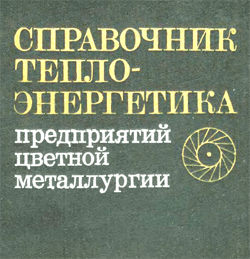
 Bagrov, Berlin – Handbook of thermal power engineers of non-ferrous metallurgy enterprises
The Bagrov, Berlin Handbook – Handbook of Thermal Power Engineers for Non-Ferrous Metallurgy Enterprises contains basic information on metallurgical thermal engineering and industrial thermal power engineering, descriptions of the designs of drying and roasting furnaces, smelting units and converters, heating and heat-treatment furnaces, as well as calculation methods and examples for these units.
The Bagrov, Berlin Handbook – Handbook of Thermal Power Engineers for Non-Ferrous Metallurgy Enterprises presents basic data on thermodynamics and heat transfer. It also provides the performance characteristics of refractory and thermal insulation materials. The operation of industrial boilers, steam turbines, recuperators, and evaporative cooling units is discussed.
The Bagrov, Berlin Handbook – Handbook of Thermal Power Engineers for Non-Ferrous Metallurgy Enterprises is intended for a wide range of employees in the non-ferrous metallurgy industry. It may be useful to specialists working in metallurgical thermal engineering and industrial thermal power engineering.
Non-ferrous metallurgy is one of the most energy-intensive sectors of the national economy. Energy costs across the industry average approximately 20% of the total cost of raw material extraction and metal production, reaching 55% of the cost of some non-ferrous metallurgy products. The significant energy intensity of non-ferrous metal production underscores the importance of rational use and conservation of fuel and energy resources.
The “Guidelines for Economic and Social Development for 1980-1985 and for the Period to 1900” state:
“Improve the use of fuel and energy resources, reduce the consumption of oil and petroleum products as boiler and furnace fuel, and develop nuclear energy at an accelerated pace.” The Ministry of Non-Ferrous Metallurgy consistently places great emphasis on increasing the efficiency of fuel and energy resource use, reducing energy costs, and developing the industry’s energy sector.
One of the main goals of this publication is to address the rational use of fuel and energy resources in pyrometallurgical and process units. Therefore, the reference book provides modern calculation methods for the main units used in non-ferrous metallurgy, such as drying and roasting furnaces, smelting furnaces and converters, heating and heat-treating furnaces, and others. Examples of calculations for the described equipment are provided to ensure successful application of these methods.
Increasing the utilization of secondary (by-product) energy resources is an important way to conserve fuel and energy resources. Therefore, the reference book describes the designs, calculation methods, and calculation examples of the main heat recovery units, namely, waste heat boilers, recuperators, and evaporative cooling units.
Furthermore, another method of heat conservation should be noted: retaining heat directly within the unit through the use of low-thermal-conductivity insulation materials. By carefully selecting highly resistant refractory materials, cooling of certain components of a high-temperature unit can sometimes be avoided. Therefore, one chapter of the handbook is devoted to describing the performance characteristics of modern refractory materials.
Because the publication is primarily intended for employees of industrial enterprises, where existing instruments and equipment, instructions, and other regulatory documents use units of measurement in older systems, these systems are used in the handbook, and Chapter 1 provides brief information on the SI and conversion from one system of units to another.