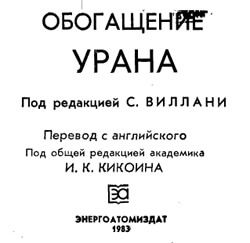
 Villani – Uranium Enrichment
Villani’s book, “Uranium Enrichment,” contains a review of works united by a single topic: the separation of uranium isotopes. The review was compiled by leading experts from the United States, France, Germany, Italy, and the Netherlands, using materials from major industrial companies.
Villani’s book, “Uranium Enrichment,” is intended for engineering and technical professionals, as well as undergraduate and graduate students in relevant fields.
Isotope separation is a relatively old problem, as physicists and physical chemists have long sought to investigate so-called isotope effects. This book presents the fundamental questions underlying various isotope separation methods. These questions have been addressed in numerous journal articles, but systematic reviews are virtually nonexistent. This book fills this gap. It describes diffusion, centrifugal, laser, and other isotope separation methods. Each of these methods is covered in a dedicated review, written by authoritative experts in the field.
It is known that the most industrially developed method for separating uranium isotopes is diffusion. However, as rightly pointed out in the preface to the English edition, the industrial technology of diffusion isotope separation is classified. Only in recent years have individual articles appeared outlining the scale of industrial production in the United States and some technical details related to this technology.
The theory of diffusion isotope separation is described in considerable detail in D. Massignon’s article. It is based on articles published in various journals. The same applies to the centrifugal method, which has recently begun to be used on a semi-industrial scale in several countries—the United Kingdom, the Netherlands, Germany, the United States, and Japan.
Isotopes of many elements are widely used for scientific research and for national economic needs. This book by Villani, Uranium Enrichment, will undoubtedly be useful for specialists studying the problems of separating stable isotopes.
Unfortunately, Villani’s book, Uranium Enrichment, does not devote space to describing the electromagnetic method of isotope separation, which has significant practical significance. The authors rightly note that laser and plasma isotope separation methods are still in the laboratory development stage, yet the materials presented in the reviews by K. P. Robinson, R. J. Jensen, F. Boschoten, and N. Natrath may nevertheless be of interest to physicists and engineers interested in developing these promising methods.
We can be confident that Villani’s book, Uranium Enrichment, will find a wide readership.