

 Vysotsky – Handbook of Oil and Gas Fields in Foreign Countries. Book 1: Europe, North and Central America, 1976
This reference work on oil and gas fields in foreign countries consists of two volumes. The first volume provides a tabular description of oil and gas fields, organized by petroleum-bearing basins in Europe, North America, and Central America. The second volume covers basins in Africa, South America, the Near and Middle East, South Asia, Central Asia, the Far East, Southeast Asia, Oceania, Australia, and New Zealand.
The reference work provides a geological overview of each basin, including the year in which its commercial oil and gas potential was established, as well as the total number of oil and gas fields discovered.
The descriptions of individual oil and gas fields include the following data: year of discovery, location, structural form, age and name of the productive strata, depth of the oil- and gas-bearing horizons, types of oil (or gas) accumulations, oil density, gas composition, and the size category of the field (based on the volume of recoverable oil and gas reserves).
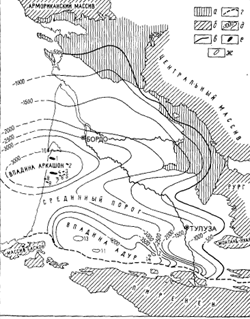
The descriptions are supplemented by cross-sections and structural maps illustrating the positioning of the oil and gas accumulations. General overview maps showing the locations of the fields are also provided.
This reference work is intended for geologists and geophysicists—both in industry and research organizations—who specialize in petroleum geology, as well as for faculty and staff at higher education institutions.
By the beginning of 1975, approximately 32,000 oil and gas fields had been discovered worldwide. This reference guide aims to provide a concise overview of the most representative types of oil and gas fields—specifically those with significant reserves, those characterized by unique occurrence conditions, and those discovered in new regions in recent years. This guide to oil and gas fields in foreign countries is intended to serve as a foundational resource for identifying patterns in the distribution of oil and gas deposits, assessing the hydrocarbon potential of various territories, estimating prospective reserves, addressing theoretical issues in petroleum geology, and conducting other research essential for refining exploration methodologies for as-yet-undiscovered fields.
The guide is organized using a standardized tabular format, with minor variations resulting primarily from a lack of published data for certain countries. (In the tables, a dash indicates “no data available.”)
Oil and gas fields are categorized by continent and by oil- and gas-producing nation; within each country, they are further organized by oil and gas-bearing basins. For each continent (or region), the guide provides a brief overview of its current structural framework and the locations of oil and gas-bearing basins—including those with proven potential, those considered prospective, and those with uncertain potential. It also includes information on recent discoveries or individual fields located in countries that are not otherwise detailed in the guide due to the limited number of fields found there.
Oil and gas-bearing basins—or portions thereof—within individual countries are described using the following tables: a summary of the lithostratigraphic sequence, the distribution of hydrocarbons throughout that sequence, and the spatial arrangement of the fields. Since some oil and gas-bearing basins span the territories of several adjacent countries, information regarding them is presented accordingly, organized by country. For instance, in Europe, the Central European oil and gas-bearing basin extends across seven countries: the United Kingdom, Norway, Denmark, the Netherlands, the Federal Republic of Germany (FRG), the German Democratic Republic (GDR), and Poland. Data for this basin are provided based on the specific segments located within each of these countries.
The core of the *Handbook of Oil and Gas Fields in Foreign Countries* consists of tables detailing the characteristics of oil and gas fields. These tables provide information on the location of each field, its structural form, the types of deposits, their stratigraphic and hypsometric positioning, and more. The fields are also characterized by their proven recoverable oil and gas reserves. In many instances, data on initial explored reserves were unavailable; therefore, their approximate scale was estimated based on the volume of oil already extracted or currently being produced, the dimensions of the traps, and other indicators. Consequently, the tables categorize these fields into specific quantitative reserve classes.