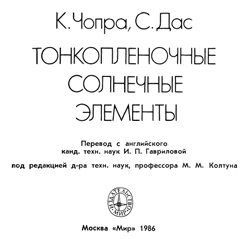
Chopra, Das – Thin-film solar cells
The monograph by Chopra and Das, “Thin Film Solar Cells,” is devoted to thin films based on semiconductor materials used as solar cells. The book describes the deposition methods and physical properties of multilayer films of various semiconductors, dielectrics, and metals. Particular attention is paid to films based on copper sulfide and silicon. New types of solar cells and new directions in the development of high-efficiency cells are discussed.
The book by Chopra and Das, “Thin Film Solar Cells,” is intended for specialists in the fields of solar energy, semiconductor devices, and thin-film electronics, as well as undergraduate and graduate students in relevant fields.
This book by Chopra and Das, “Thin Film Solar Cells,” is devoted to a pressing issue in modern semiconductor solar energy: the creation and study of thin-film solar cells.
In semiconductors with direct optical transitions, the absorption coefficient of radiation is so high that absorption of the photoactive part of the solar spectrum occurs in a layer no more than a few micrometers thick. At the same time, the majority of solar cells produced are made from monocrystalline semiconductor wafers approximately two hundred to three hundred micrometers thick, as thinner wafers cannot be used in mass production due to their increased fragility.
This gap between theoretical and practical capabilities holds significant potential for further cost reductions in solar cells, which could make the use of solar cells feasible and economically viable not only in photoautomation systems or autonomous power supplies for spacecraft, but also in terrestrial power systems of varying capacities. It is therefore not surprising that researchers in many countries are currently devoting attention to the development of thin-film solar cells based on various semiconductor materials. If the efficiency of converting solar radiation into electrical energy in thin-film cells with a photoactive layer several micrometers thick reaches values as high as those characteristic of monocrystalline solar cells, the cost of the electricity they generate will be very close to that generated by nuclear or even thermal power plants.
The authors of this book, Chopra and Das, “Thin-Film Solar Cells,” are renowned Indian specialists K. L. Chopra and S. R. Das, who also worked for many years at research centers in the United States and Canada. They are well known to Soviet researchers for their articles and presentations at international conferences. In the thin film laboratory of the Indian Institute of Technology in Delhi, they developed a number of promising technologies for the fabrication of thin-film solar cells and improved their design.
Despite numerous publications on this topic, a monograph summarizing the results of their research and outlining ways to further improve the properties of thin-film solar cells has been missing from both foreign and domestic literature. This book by Indian specialists fills this gap. The authors summarize the achievements of scientists from various countries, including the Soviet Union, in this field, demonstrate the various technological approaches used to create thin-film solar cells, and analyze the advantages and disadvantages of the basic designs of such cells based on various materials. Their own research experience allowed the authors to provide a thorough and comprehensive analysis.
In the Soviet Union, research related to the creation, study of the properties, and testing of thin-film solar cells has been successfully conducted for many years by numerous scientific organizations in Moscow, Leningrad, Kiev, Kharkov, Chisinau, Tashkent, Yerevan, Tallinn, Vilnius, Odessa, and Chernivtsi.
Along with classic, purely thin-film cell designs, combined film-monocrystalline structures have recently been actively developed, combining simplicity and cost-effectiveness of manufacture with a relatively high efficiency. Research teams led by Academician Zh. I. Alferov and Corresponding Member of the USSR Academy of Sciences N. S. Lidorenko have produced solar cells with an efficiency of approximately 30% based on gallium arsenide and 16…18% based on silicon. These cells are multilayer structures in which perfect film layers are created on single-crystal substrates (usually made of relatively inexpensive grades of gallium arsenide and metallurgical silicon) using vapor and liquid epitaxy. It is precisely these combined film-crystal solar cells that will likely attract increasing attention from researchers and will find widespread mass application in the near future. The experience gained in creating single-crystal and purely thin-film systems, including the results of the work described in this monograph, will be invaluable in optimizing the properties and technology for producing complex combined structures.
Sections of Chopra and Das’s book “Thin-Film Solar Cells” have been omitted from the translation. The contents of these sections are well known to Soviet readers from the original Russian and translated foreign publications listed in the list of additional references. These sections primarily cover general issues in the study of the photovoltaic properties of semiconductors and semiconductor devices, solar cell production technology and metrology, and research into the characteristics of photoelectrochemical solar cells. The list of additional references also includes a small selection of domestic publications, providing insight into the diversity and breadth of development and research conducted in the USSR into the properties of thin-film solar cells.