

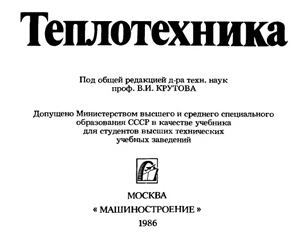
 Arkharov, Isaev – Thermal engineering (edited by Krutov)
The textbook *Thermal Engineering* by Arkharov and Isaev (edited by Krutov) covers the fundamentals of thermodynamics and heat transfer theory, fuels and their combustion, and the design principles and components of boilers, industrial furnaces, steam and gas turbine units, internal combustion engines, jet engines, and more.
The book *Thermal Engineering* by Arkharov and Isaev (edited by Krutov) presents calculations for heating, ventilation, and air conditioning systems and outlines the fundamentals of energy technology.
The “Main Directions for Economic and Social Development for 1986–1990 and the Period up to the Year 2000” call for shifting production toward a predominantly intensive development path, accelerating economic growth through scientific and technological progress. Scientific and technological progress is largely characterized by a gradual increase in the amount of energy humans use in production processes. The process of increasing energy generation for production needs continues today with even greater intensity through the construction and commissioning of numerous high-capacity thermal and nuclear power plants. Key provisions of the long-term Energy Program call for the accelerated development of nuclear power. Large thermal power plants are slated for construction based on coal from the Ekibastuz and Kansk-Achinsk fuel and energy complexes. The development of fuel and energy sectors must be aligned with the goal of reliably meeting the country’s needs for all types of fuel and energy, while systematically implementing a targeted energy-saving policy across all sectors of the national economy.
In the coming years, the combined production of electricity and heat is expected to expand.
Plans are in place to increase the use of natural gas in the national economy by raising extraction levels to 835–850 billion cubic meters by 1990, while simultaneously increasing the recovery rate of gas condensate. The production of vehicles running on compressed and liquefied gas will expand significantly. By 1990, the share of freight turnover handled by diesel-powered vehicles will rise to 60%. Further development of transport power plants is also anticipated.
Continued growth in fuel and energy production, combined with improvements to the fuel-energy balance, will make it possible to significantly increase the level of electrification across all sectors of the national economy, while ensuring the utmost conservation of fuel and energy resources and the protection of the environment.
Engineers play a vital role in achieving these objectives; they are tasked with designing power plants and machinery based on the latest scientific and technological advances, as well as ensuring their efficient operation. Consequently, the subject of “Thermal Engineering” has been incorporated into the curricula for many engineering specializations, and a syllabus has been approved—forming the basis for this textbook.
This textbook provides a comprehensive overview of thermal engineering—knowledge essential for engineers to operate thermal equipment efficiently and to identify and utilize secondary energy resources.
Download – Arkharov, Isaev – Thermal engineering (edited by Krutov) >>