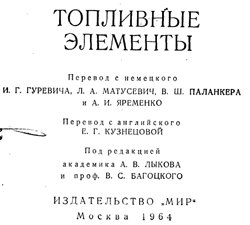
 Justi, Winsel – Fuel Cells (Eds. Lykov, Belgotsky)
The development of fuel cells is a key area of future-oriented research concerning the direct conversion of chemical energy into electrical energy, attracting significant interest from a wide range of scientists.
The book *Fuel Cells* by E. Justi and A. Winsel (edited by Lykov and Belgotsky) details the work of the renowned German specialist E. Justi and his colleagues on the development of highly active gas electrodes for hydrogen-oxygen fuel cells operating at temperatures up to 100°C. The book offers a valuable, detailed overview of the current state of fuel cell research across various countries. Also noteworthy is the chapter comparing fuel cell properties with certain processes occurring in living organisms.
*Fuel Cells* by E. Justi and A. Winsel is intended for scientists and engineers interested in new developments in the energy sector, as well as for faculty and students at universities specializing in chemistry, chemical technology, physics and engineering, and energy studies.
In 1962, the Foreign Literature Publishing House released a Russian translation of the book *The Highly Active Hydrogen Diffusion Electrode* by E. Justi, M. Pilkuhn, W. Scheibe, and A. Winsel. That work generated great interest among Soviet readers engaged in or interested in the direct conversion of chemical energy into electrical energy via fuel cells.
The new book by E. Justi and A. Winsel, *Fuel Cells*, is essentially a second edition—somewhat revised and significantly expanded—of the aforementioned work. While the first edition focused on a single fuel cell electrode (with other aspects of fuel cell operation addressed only incidentally), the present volume takes a different approach: it is dedicated to the entire subject of fuel cells as a whole. The new book *Fuel Cells* by Justi and Winsel (edited by Lykov and Belgotsky) presents a detailed account of the research conducted by Prof. E. Justi and his numerous associates on the development of hydrogen-oxygen fuel cells. In addition to sections on the study of the highly active hydrogen electrode (carried over from the first edition), the new book provides a detailed description of the manufacturing technology and properties of active oxygen electrodes. The experimental work described in the book played a significant role in the development of high-power-density hydrogen-oxygen fuel cells capable of operating at moderate temperatures (up to 100°C).
The book *Fuel Cells* by Justi and Winsel also includes a comprehensive overview of the current state of fuel cell technology (Chapter IX). Leading fuel cell developers from many countries contributed to this review, enabling a comparison of results obtained at various research centers. This overview is the most complete published to date.
The authors wrote a new chapter (Chapter X) specifically for the Russian edition, discussing the analogies between the electrochemical conversion of chemical energy and the energy conversion processes occurring in living organisms. While this topic has recently attracted increasing interest from biologists, electrochemists, and physicists alike, it has not previously been presented in a comprehensive overview.
It is anticipated that this new book by E. Justi and A. Winsel—like their first—will prove valuable to scientists and engineers across various disciplines who are interested in fuel cell technology.
Download – Justi, Winsel – Fuel Cells (Eds. Lykov, Belgotsky)>>