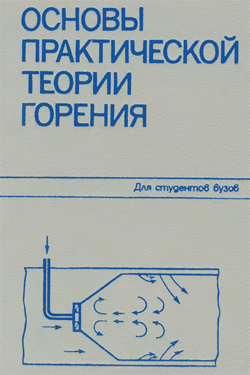
 Pomerantsev – Fundamentals of the Practical Theory of Combustion. Study Guide
Pomerantsev’s book, Fundamentals of Practical Combustion Theory, covers combustion statics and dynamics, combustion aerodynamics, ignition and flame propagation, and the combustion of carbon and natural fuels. Methods for solving practical problems are also presented. The first edition was published in 1973. The second edition significantly revised several chapters, supplemented others with new material, and reduced the number of examples due to the 1983 publication of the “Collection of Problems in Combustion Theory,” which serves as an appendix to this book.
Kinga Pomerantsev, Fundamentals of Practical Combustion Theory, is intended for students majoring in power engineering*, chemistry, and metallurgy. This textbook is also intended for students studying engineering calculations.
A thorough understanding of the combustion process in power and transport units, essential for practical combustion calculations at various stages, requires a detailed study of combustion theory by students majoring in power engineering. The course on combustion theory largely synthesizes information from the fundamental heat engineering and physical-chemical disciplines, teaching the consistent analysis of complex phenomena. Such analysis typically involves a series of approximations, which clarify the key relationships between combustion processes and the combustion domain.
The materials in this book, Pomerantsev – Fundamentals of Practical Combustion Theory, are based on lectures on combustion theory given at the M. I. Kalinin Leningrad Polytechnic Institute in the Physics and Mechanics, Power Engineering, and Physics and Metallurgy departments.
This course was initiated in the 1930s by N. N. Semenov. G. F. Knorre then continued the lectures, devoting them to the comprehensive study of combustion processes. The lecture materials expanded as the theory developed and was confirmed experimentally, as it increasingly penetrated into the analysis of industrial units, and with the beginning of combustion calculations.
Pomerantsev’s book, “Fundamentals of Practical Combustion Theory: A Study Guide,” provides calculation formulas. Some of these are simplified and contain a number of assumptions to approximate the solution of technical combustion problems. Examples, which are included in many sections of the book, serve the same purpose; examples of calculating the burnout of a flame and a layer of natural fuel illustrate the capabilities of computational analysis of even such complex processes. The formulas and solutions presented in Pomerantsev’s book, “Fundamentals of Practical Combustion Theory: A Study Guide,” form the basis of mathematical models of combustion processes in technical devices and can be used in computer-based calculations.
The first edition of “Fundamentals of Practical Combustion Theory” was published in 1973 and became widely used in heat engineering circles. In 1983, Energoatomizdat, with almost the same team of authors, published a companion book, “Collection of Problems in Combustion Theory,” which offers a large number of examples and problems with answers and outlines solutions. Therefore, in this edition, along with some rearrangement of material, additions, and changes to the interpretation of questions, the number of examples has been somewhat reduced. Examples of calculations using a computer are provided.
Download- Pomerantsev – Fundamentals of the Practical Theory of Combustion. Study Guide>>