

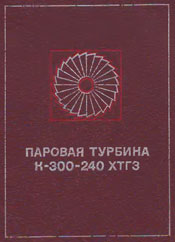
Steam turbine K-300-240 KhTGZ – Editorial office of Yu. F. Kosiak
The book Steam turbine K-300-240 KhTGZ – Editorial office of Yu. F. Kosiak examines the design of the K-300-240 turbine and its individual elements, the control system and the design of individual control devices, the starting and thermal diagrams of the unit, the design of the capacitor, the layout and mode features of the turbine. The experience of installation, adjustment and operation of the turbine is described.
The book Steam turbine K-300-240 KhTGZ – Editorial office of Yu. F. Kosiak is intended for engineering and technical workers of power plants, design, construction, adjustment and repair organizations.
Dozens of units with a capacity of 300 MW with KhTGZ turbines are in operation at the country’s power plants. Some new power stations will also be equipped with turbines. Therefore, a detailed study by energy-operators of a 300 MW turbine installation is of particular importance.
At the Kharkiv Turbine Plant (KHTZ), the development of steam turbine engineering is aimed at ensuring the growth of the power industry based on modern technology and is characterized by a continuous increase in the unit capacities of units and an increase in efficiency both due to the increase in parameters and due to the improvement of structural and schematic solutions. The creation of the K-300-240 turbine is one of the stages of this development.
Download – Steam turbine K-300-240 KhTGZ – Editorial office of Yu. F. Kosiak >>
During the design period, K-300-240 KhTGZ and LMZ turbines were intended to carry the base load in power systems, their production was supposed to ensure high rates of development and increase the level of economic efficiency of children’s energy. To realize these possibilities, the power of the turbines was chosen to be 1.5-2.0 higher than the power of the K-200-130 and 130 turbines produced at the time of the plant, and the initial parameters of the steam were taken as supercritical pressure of 23.5 MPa – 1 kgf/cm2) and temperature of 560°С.
For the K-300-240 turbine, a supercritical steam pressure is adopted, which, being 1.47 MPa (15 kgf/cm2) higher than the Czech one, ensures stable operation of the direct-flow boiler. The further increase in pressure is associated with significant difficulties in the production of pipelines and valve bodies and turbine cylinders.
The level of the initial temperature is selected from the conditions of achieving the maximum economy of the cycle without the use of rather expensive austenitic steels in the boiler, turbine and system of high-temperature steam pipes.
A very significant economic effect is achieved thanks to the doubling of the turbine capacity – when constructing a power plant with a capacity of 2400 MW with K-300-240 turbines, the cost of 1 kW of installed capacity is almost 17% lower than for a power plant with a capacity of 1200 MW with K-160-130 turbines. by 1% and reduce its specific material capacity by 12% compared to the K-160-130 turbine. At the same time, operating costs are reduced due to a reduction in the staff ratio for power plants by more than 2 times.
The transition to supercritical steam parameters and the doubling of power together with the use of the latter achieved in the field of aerodynamics and new design solutions made it possible to reduce the specific heat consumption of the K-300-240 turbine compared to the K-160-130 turbine by 8.5%.
The first K-300-240 turbine was produced by the plant in 1960. During the time that has passed since the release of the first turbine, details that limit the reliability of the turbine’s operation have been identified, thermal tests have shown a reduced economy compared to the warranty, some other defects in the operation of the turbine have appeared, explained by the novelty of the design associated with the transition to supercritical parameters, a sharp increase in the unit power of the unit and a number of other factors.
A lot of work to eliminate the identified defects is carried out by KhTGZ both on the manufactured and on the turbines in operation. The generalization of these works was the creation of the K-300-240-2 turbine, which has been produced by the plant since 1970. The main attention is paid to achieving the design economy of the turbine by improving the flow of parts of all cylinders, improving the performance of end seals, increasing maneuverability and ensuring maximum reliability of the unit
Constant work on improving the reliability of the K 300-240 turbines and the technical level and operation at the GRES led to the fact that the average availability factor of the turbines in 1974 reached 99%
Thanks to the plant’s efforts to improve the turbine’s components, ensure its technology, reliability and high efficiency, the K-300-240-2 turbine was awarded the State Quality Mark.
The production of energy equipment at the KhTGZ in fairly large batches not only ensures high rates of energy development, but also contributes to the reduction of the specific labor intensity and cost of the manufactured equipment, despite the additional costs of modernizing the turbine. Thus, the labor intensity of the K.-300-240 steam turbines was 0.83 standard hours/kW against 0.62 standard hours/kW for turbines produced in 1976.
This book provides a detailed description and analysis of the design features of the most important components of the K-300-240. Along with the main aspects of the turbine design, the thermal scheme and layout, the steam distribution and regulation systems, the issues of installation, features of operational modes, adjustment and testing are considered.
Constant work on increasing the reliability of the K 300-240 turbines and the technical level and operation at the GRES led to the fact that the average availability ratio of the turbines in 1974 reached 99%
Thanks to the plant’s efforts to improve the turbine’s components, ensure its technology, reliability and high efficiency, the K-300-240-2 turbine was awarded the State Quality Mark.
The production of energy equipment at the KhTGZ in fairly large batches not only ensures high rates of energy development, but also contributes to the reduction of the specific labor intensity and cost of the manufactured equipment, despite the additional costs of modernizing the turbine. Thus, the labor intensity of the K.-300-240 steam turbines was 0.83 standard hours/kW against 0.62 standard hours/kW for turbines produced in 1976.
Download – Steam turbine K-300-240 KhTGZ – Editorial office of Yu. F. Kosiak>>