

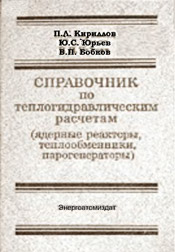
 Kirillov – Handbook of Thermal-Hydraulic Calculations
The book *Handbook of Thermal-Hydraulic Calculations* by Kirillov provides fundamental information on the thermal physics of nuclear power installations. It offers a systematic compilation of formulas, graphs, and nomograms for the thermal-hydraulic design of various types of nuclear reactors, heat exchangers, and steam generators. The text also includes recommendations for calculating fluid dynamics and heat transfer for a range of coolants.
Intended for researchers, design engineers, and developers of nuclear reactors and heat-exchange equipment for nuclear power plants.
Download -Kirillov – Handbook of Thermal-Hydraulic Calculations >>
There has long been a need for reference material dedicated to thermal-hydraulic calculations in the field of nuclear power engineering. For various reasons, however, such publications were not produced, forcing specialists to rely on general thermal engineering handbooks—sources that often fail to address, or only superficially cover, issues specific to the nuclear power sector. Modern nuclear power, both in the USSR and abroad, is primarily based on water-cooled reactors (specifically the VVER and RBMK types in the Soviet Union). The future of nuclear power lies in the expanded reproduction of nuclear fuel, as the world’s reserves of such fuel—much like those of traditional energy resources—are finite. In the USSR, the BN-350 and BN-600 breeder reactors have been operated successfully, and more powerful liquid-metal-cooled reactors are currently in the design phase. Between 1979 and 1982, the publishing houses Atomizdat and Energoizdat released a series of textbooks titled *Nuclear Reactors and Power Plants*, edited by Academician N. A. Dollezhal. These volumes provide descriptions of nuclear reactor characteristics, methodologies for calculating the thermophysical parameters of channels with various structural designs, analyses of thermal-hydraulic reliability, and more.
The book *Design of Power Plants with High-Temperature Gas-Cooled Reactors*, edited by a Corresponding Member [of the Academy of Sciences], focuses on calculations for new types of high-temperature thermal and fast-neutron reactors. …by I. Ya. Yemelyanova, published by Energoizdat in 1981. Issues concerning heat transfer and fluid dynamics, as well as methods for the thermophysical design of reactors cooled by a dissociating gas, are addressed in a series of books written by specialists at the Institute of Nuclear Energy of the Academy of Sciences of the Byelorussian SSR, edited by V. B. Nesterenko (a Corresponding Member of the Academy of Sciences of the Byelorussian SSR) and published between 1978 and 1982.
Many modern methods for calculating convective transport in heat exchangers are reflected in a book by Academician… Academy of Sciences of the Lithuanian SSR, A. A. 3…by Žukauskas (1982). Issues concerning heat and mass transfer and fluid dynamics in two-phase flows within nuclear power plants are covered in a monograph by Academician M. A. Styrikovich et al. (1982). These books serve as valuable sources of reference material, which explains why the coverage of these topics in the present handbook is not exhaustive.
Given the specific focus of this handbook—which aims to provide primarily computational recommendations—we have kept the accompanying text and explanations to a minimum, without delving into the underlying physical processes. Consequently, we assume that users of this handbook possess the necessary background knowledge—equivalent to that acquired in university-level heat transfer courses for thermal engineering majors—and are familiar with relevant monographs and textbooks (such as those by Academician S. S. Kutateladze, Corresponding Member of the USSR Academy of Sciences B. S. Petukhov, Professor V. P. Isachenko, and others).
Equipment used in nuclear power installations is characterized by a relatively narrow range of operating parameters, yet it requires recommendations of higher precision than those used in conventional power engineering, as such components typically operate under more intense conditions. Most challenges in nuclear power engineering pertain to internal heat transfer and fluid dynamics. In modern nuclear power plant design, there is a clear shift from calculating average values to determining local values. While this trend is generally applicable, it is particularly critical when designing high-intensity components, such as reactor core assemblies, steam generators, and heat exchangers. This necessitates knowledge not only of average velocities but also of detailed velocity distributions across cross-sections, temperature distributions over surfaces, and the potential for deviations between actual and calculated values. This principle is consistently applied throughout the work. …by the thermophysicists of the Institute of Physics and Power Engineering—a field to which V. I. Subbotin, a Corresponding Member of the USSR Academy of Sciences, made a significant contribution. It was not always possible to consistently apply this approach throughout the handbook, as methods for calculating local quantities are often either not yet developed into practical engineering procedures, remain the exclusive domain of research scientists, or are excessively cumbersome.
This publication may serve as a textbook or study aid for instructors and students at universities specializing in energy, engineering physics, or polytechnic studies.
The appendices contain tables detailing the physical properties of water and various other heat-transfer fluids—such as CO₂ and helium—that are used in nuclear reactors or in experimental research.
The authors would be grateful for any comments, suggestions for improvement, or clarifications; please forward such feedback to the authors or the publisher.
Download – Kirillov – Handbook of Thermal-Hydraulic Calculations >>