

 Kudryashov, Frolov — Heat Engines
The methodological guidelines “Heat Engines” by Kudryashov and Frolov contain instructions for practical sessions and laboratory work focused on heat engines.
Machines that convert any form of energy into mechanical work are called engines. Machines that convert heat into mechanical work are known as heat engines. Currently, the heat required for these engines is derived from organic fuels—through chemical reactions—or from nuclear fuel—through nuclear reactions. Organic fuels used in industrial thermal power installations include bituminous coal, anthracite, lignite, peat, oil shale, wood, petroleum, associated petroleum gas, natural gas, and various products derived from their processing. Nuclear fuels may consist of isotopes of uranium or plutonium, with uranium and thorium serving as the raw material base. Nuclear fission, which releases energy in the form of heat, occurs during the splitting of uranium-235, uranium-233, or plutonium-239. Another type of nuclear reaction—fusion (the combining of deuterium, tritium, or lithium nuclei)—is currently utilized only for explosive purposes (as in a hydrogen bomb); a method for achieving a controlled thermonuclear reaction has yet to be developed.
In industrial settings, electrical energy is generated from heat by first converting it into mechanical work. Modern technology does not yet allow for the creation of high-capacity systems capable of generating electricity directly from heat. Developing a way to convert heat into electricity with high efficiency—without the intermediate step of mechanical work—would represent a major technological advancement. In such a scenario, the need for thermal power plants—as well as the requirement for installing various other types of heat engines—would be eliminated. Heat engines are generally characterized by relatively low efficiency, significant operational complexity, and the need for highly skilled maintenance.
In thermal power plants—and indeed in any industrial sector where heat is harnessed to drive high-capacity machinery—heat engines are indispensable. As a fundamental component of the entire thermal energy sector, heat engines are currently employed extensively across a wide range of economic activities.
The combustion of fuel and the subsequent release of heat can occur either within the engine itself or in a separate, external unit. In some systems, the products of combustion act directly as the “working fluid”—the medium that facilitates the conversion of heat into mechanical work. In other systems, the combustion products transfer their heat to a secondary substance (such as water), which then undergoes a phase change (becoming steam) and serves as the working fluid within the heat engine. Thus, in the first case, the engine’s thermodynamic cycle operates without an intermediate heat-transfer medium, whereas in the second case, such an intermediate medium is utilized.
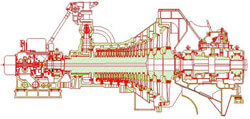
The conversion of heat into mechanical work is achieved through five primary types of heat engines: steam engines, steam turbines, gas turbines, internal combustion engines, and jet engines. The steam turbine is the predominant type of heat engine used in thermal power plants; it is examined in greater detail via the link provided below.