

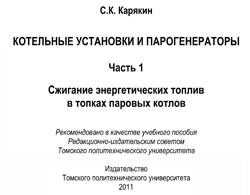
 Karyakin — Boiler Installations and Steam Generators: Combustion of Power-Generation Fuels in Steam Boiler Furnaces
The textbook “Boiler Installations and Steam Generators. Part 1: Combustion of Power-Generation Fuels in Steam Boiler Furnaces” provides information on the fuels used in boiler installations. It covers the combustion of fuels within steam boiler furnaces, outlines the technologies for preparing various fuels for combustion, analyzes fuel combustion processes, and examines the organization of the furnace process. Attention is also given to the design of different types of furnaces and the burner equipment employed within them.
This textbook was prepared by the Department of Steam Generator Engineering and Steam Generator Installations and is intended for students enrolled in the field of study 140100, “Thermal Power Engineering and Heat Technology.”
In general, the term “fuel” can be applied to any combustible substance that releases a significant amount of heat upon combustion.
Depending on its intended use, fuel can be classified as energy-generating, technological, domestic, automotive (for carbureted or diesel engines), rocket propellant, and so on.
“Energy-generating fuel” refers to fuel that is economically viable for producing large quantities of heat in energy facilities, such as thermal and nuclear power plants, industrial boiler installations, and other energy-producing systems.
Energy-generating fuels can be categorized as either organic or nuclear.
Organic fuel consists of complex organic-mineral compounds formed from the remains of plant and animal life through a long-term transformation process occurring under specific geological conditions—namely, under high pressure and in the absence of air.
Nuclear fuel consists of heavy metals, such as uranium and plutonium. The decay of the radioactive nuclei of these atoms releases a substantial amount of thermal energy. Nuclear fuel is used in nuclear power plants.
Boiler installations at thermal power plants rely exclusively on organic fuel. Since this manual is intended for students specializing in “Thermal Power Plants,” all discussions regarding fuel herein focus specifically on organic energy-generating fuel—referred to hereafter simply as “fuel.”
Based on their initial state of matter, fuels are classified into three types: solid, liquid, and gaseous. All types of fuel can be either natural (extracted from the Earth) or artificial (produced through the processing of natural fuels).
Natural solid fuels include firewood, peat, lignite (brown coal), bituminous coal, semi-anthracite, anthracite, and oil shale. Artificial solid fuels include wood-processing waste (wood chips, sawdust, etc.) and coal-preparation waste (middlings and tailings); charcoal; briquettes made from wood, peat, or coal; peat-based or coal-based semi-coke and coke; as well as petroleum coke. Cereal husks are also used as an artificial solid fuel in the energy sector (primarily in small-scale energy applications).
Crude oil, which is a complex mixture of liquid organic substances, can be classified as a natural liquid fuel.
Fuel oil (mazut)—a heavy residual product obtained from the deep processing of crude oil—is a widely used artificial liquid fuel for energy production.
Gaseous fuel is a mechanical mixture of combustible and non-combustible gases, containing small amounts of water vapor and dust.
Natural gaseous fuels include natural gas and associated (oil-field) gas; like crude oil, these are of biochemical origin. “Natural gas” refers to gas that accumulates within rock formations, forming dedicated gas fields. “Associated gas” refers to gas that is dissolved in crude oil; it may be released from the oil and collect above it as a “gas cap,” forming oil-and-gas fields.
Artificial gases include gaseous by-products of metallurgical processes, such as coke-oven gas and blast-furnace gas.