

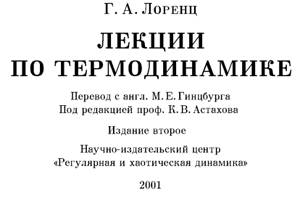
 Lorentz – Lectures on thermodynamics
Lorentz’s *Lectures on Thermodynamics* covers the thermodynamic topics that collectively constitute what is known as “classical thermodynamics.” The first and second laws of thermodynamics are presented in considerable detail, along with their applications to binary systems, adiabatic processes, mixed crystals, and more.
Authored by one of the foremost theoretical physicists of the late 19th and early 20th centuries, *Lectures on Thermodynamics* will undoubtedly appeal to a wide audience—ranging from undergraduate and graduate students to professional mathematicians, physicists, and historians of science.
H. A. Lorentz is widely recognized as a preeminent theoretical physicist of his era. Soviet readers are already familiar with his remarkable works published in Russian translation, such as *The Theory of Electrons* (GTTI, 1934), *Theory of the Electromagnetic Field* (GTTI, 1933), *Statistical Theories in Thermodynamics* (ONTI, 1935), and *Lectures on the Theory of Radiation* (GTTI, 1935).
These books demonstrate the author’s exceptional ability to present material with utmost clarity, precision, and—I would add—remarkable elegance. These qualities, characteristic of Lorentz both as a thinker and as a writer, are equally evident in his lectures on thermodynamics, which form a chapter of his broader course on theoretical physics. There is, therefore, no need to justify the publication of a Russian translation of this specific chapter from Lorentz’s theoretical physics course. In *Lectures on Thermodynamics*, Lorentz outlines the essence of the first and second laws of thermodynamics and presents numerous applications—such as to binary systems—without dwelling at length on the analysis of fundamental concepts like heat and work. The book’s brevity necessitates a certain conciseness of exposition, yet this comes at no cost to clarity. It is entirely accessible even to readers with little prior knowledge of thermodynamics; one is struck by the remarkable ease with which the author navigates the various challenges inherent in presenting these topics.
Naturally, this volume covers only those thermodynamic topics that collectively constitute what is known as “classical thermodynamics”; the reader will not find, for instance, a discussion of the Nernst theorem, an axiomatic derivation of the first and second laws, or the theory of activity.
*Lectures on Thermodynamics* reflects the state of the field as it stood at the close of the nineteenth century. The absence of these “newer” thermodynamic topics does not diminish the book’s value; readers—especially those with a particular interest in thermodynamics—will find much that is valuable and instructive in the author’s approach to the material, including a wealth of insightful observations and ideas. Indeed, while presenting “classical thermodynamics,” the author avoids the conventional path—typically characterized by an emphasis on the theory of ideal gases—in favor of a distinctive treatment of the subject’s foundations and applications. In editing the translation of this book—Lorentz’s *Lectures on Thermodynamics*—it is necessary to provide notes and to ensure only that the translation conveys the meaning and essence of the material as accurately as possible.