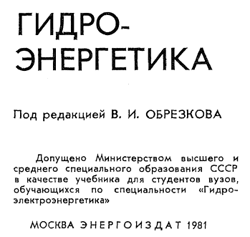
 Obrezkov – Hydropower
Over the past 15–20 years, hydropower engineering has undergone significant changes—both in its fundamental scope and, particularly, in the methods used to address the increasingly complex challenges of designing and operating hydroelectric power plants. This evolution has been driven primarily by the ever-rising demands placed on the sector, stemming from the need to balance the country’s water and fuel-energy resources while ensuring the reliability and resilience of power systems.
Meeting these requirements necessitated new theoretical approaches to solving practical problems, involving both methodological and computational innovations. Recent advances in computational mathematics and computer technology have played a crucial role in this process.
These developments have made it possible to place the solution of many hydropower problems on a fundamentally new footing, allowing for the use of mathematically more rigorous algorithms without requiring additional input data. This has led to more robust solutions that align with both the nature of the input data and the required calculation accuracy (not to mention the ability to tackle problems that were previously considered too complex to even formulate).
Hydropower engineering has increasingly moved toward the status of a mathematically rigorous technical discipline.
Significant contributions to the development of hydropower science have been made by organizations such as VNIIE, Energosetproekt, Gidroproekt, MEI, SEI, the Siberian Branch of the USSR Academy of Sciences (SO AN SSSR), ENIN, NETI, LPI, and others.
This textbook—*Hydropower Engineering* by Obrezkov—does not aim to provide a comprehensive manual for the calculations involved in the design and operation of hydroelectric facilities. Its objective is different: primarily, it seeks to help students gain a clear understanding of the physical processes occurring both within individual facilities and during their operation as part of broader power and water management systems.
The modern operating conditions of hydroelectric facilities within these systems give rise to new, more complex challenges that can only be resolved through the use of state-of-the-art, high-performance computers. Under these conditions, the modern engineer must be able not so much to use off-the-shelf formulas or even computer programs (tasks a calculation technician can handle successfully) as to correctly formulate the problem and develop a method and algorithm for its solution, tailored to specific conditions and the nature of the input data.
Accordingly, the textbook places great emphasis on the mathematical modeling of fundamental hydropower processes. Understanding these issues is greatly facilitated by the prerequisite course, “Mathematical Problems in Hydropower Engineering.”
A young specialist must also be able to competently evaluate and analyze the calculation results obtained. In the modern context, an incorrect physical interpretation of the solutions leads to erroneous—and often irreversible—outcomes during implementation.
The textbook *Hydropower Engineering* (by Obrezkov) does not include ready-made algorithms or programs for solving specific hydropower problems, as these quickly become obsolete. Nor does it include calculation examples, since these—like the calculation methods themselves—would reflect only the problems of the present day.
The content of the textbook is divided into three parts. The first part covers the technological process of converting water energy into electricity and the fundamentals of water-energy calculations; the second deals with the optimal operating modes of hydropower plants within energy and water management systems; and the third addresses the principles of designing optimal energy parameters for hydroelectric power plants. An appendix provides the technical and economic characteristics of hydroelectric construction.
This structure aligns with the curricula for hydropower engineering and related core disciplines taught at the Moscow Power Engineering Institute, the Novosibirsk Electrotechnical Institute, and the Tashkent Polytechnic Institute. The textbook also reflects many years of experience in teaching these subjects at the Moscow Power Engineering Institute (MPEI).