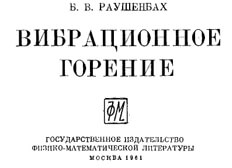
 Rauschenbach – Vibrational Combustion
Rauschenbach’s book, “Vibrational Combustion,” systematically presents a modern theory of the excitation of longitudinal acoustic oscillations by heat supply. The laws inherent in this type of oscillation are examined, with their analysis drawing extensively on information from fluid mechanics, combustion acoustics, and the theory of control and oscillation.
Books Rauschenbach – Vibrational Combustion is intended for researchers, engineers, graduate students, and senior students at universities and higher technical educational institutions dealing with combustion theory and the theory of continuous media oscillations, as well as those working in modern engine building and thermal engineering.
In recent years, the problem of exciting acoustic oscillations in a gas column where combustion occurs has become a pressing issue. This is because a number of practically important problems related to the creation of highly accelerated combustion chambers cannot be solved without a thorough analysis of the phenomenon sometimes referred to as “vibrational combustion.” This fact is reflected in a large number of articles published in international journals.
Unfortunately, the works of foreign authors are primarily devoted to instability generation in rocket engines and, therefore, may have a relatively narrow scope of application. At the same time, similar phenomena are known to be observed in industrial furnaces, experimental setups for studying combustion processes, and in a number of physical experiments (Rijke’s trumpet), etc.
Therefore, a more general consideration of the problem of acoustic vibration generation by heat transfer (in particular, combustion) has long been necessary. One of the goals set in writing this book, Rauschenbach – Vibrational Combustion, was to develop the foundations of a systematic theory of vibrational combustion, allowing for a unified approach to the entire multitude of specific cases. However, a consideration of specific engineering problems within the scope of this book would be inappropriate. This would have significantly increased the volume of Rauschenbach’s book “Vibrational Combustion,” and, most importantly, would have hindered the study of the essence of the phenomenon and the development of general methods, since the reader’s attention would inevitably be dispersed by a detailed analysis of various specific issues.
Furthermore, it should not be forgotten that engineering problems relevant today may become interesting in a few years, while those unimportant now may become the focus of future studies. Therefore, it seemed more appropriate to provide an outline of the general theory, leaving the development of specific problems to those directly involved. Only as a conclusion to the general theory are examples of its application to certain practical problems given in Chapter 10.
This stated goal largely determines both the content of Rauschenbach’s book “Vibrational Combustion” and the method of presentation. The main content of the book is the analysis of an idealized scheme (combustion in a cylindrical tube), and the experimental material largely pertains to academic experiments (combustion of a mixture in a small tube, with or without a simple stabilizer, but not combustion in real combustion chambers, engines, etc.). To make the material accessible to a wide range of engineers, the subject is presented in the simplest possible manner and in sufficient detail. Therefore, a basic background in mathematics and mechanics, as provided by our higher technical educational institutions, is sufficient for understanding the problems under consideration. Striving for simplicity and brevity, the author has often sacrificed rigor in presentation, attempting, wherever possible, to sculpt the physical essence of the phenomenon under consideration.
This book, “Vibrational Combustion,” by Rauschenbach, is not a complete summary of the current state of the art. It presents primarily results obtained by the author, some of which were published at various times in periodicals. This inevitably influenced not only the formulation of the problems and the method of their consideration, but also the content of the book. Where works by other authors are used, appropriate references are provided throughout; the absence of such references indicates that the results (both theoretical and experimental) are those of the author. In addition to a number of previously published works, the book is based on lectures given by the author to students at the Moscow Institute of Physics and Technology in recent years.
Rauschenbach’s book, “Vibrational Combustion,” is intended for senior undergraduate students and postgraduate students studying process control using modern electronic components (microprocessor technology, optoelectronics, etc.), diagnostic tools, and the most advanced, durable structural materials.
At the same time, a search for optimal management structures and personnel training was underway. Large-scale scientific research and design work were conducted.
For coal industry specialists, foreign experience in improving the technology, technology, and economics of coal production should be of great interest.
Information materials characterizing the status of various processes or equipment are published annually in the domestic press.
Currently, it is extremely important to provide a systematic overview of the state and development trends of the coal industry abroad. This clearly identifies the areas and directions in which foreign experience should be most effectively utilized to accelerate scientific and technological progress in domestic practice. It should be noted that such works have not been published in the open press for several decades.
Based on the above, the purpose of this book, Rauschenbach – Vibration Combustion, is to provide a highly concise, systematic description of the state and development prospects of the foreign coal industry in the 1980s and 1990s. both in general and in terms of key technological processes, areas and sub-sectors: reserves, volumes of coal production and consumption, processing, areas of use, safety and environmental protection issues in the development of coal deposits both by open and underground methods, energy supply, the implementation of automated control systems and automated process control systems, the level of automation of production processes and machines, the development and organization of scientific research, and the prospects for the development of the industry.
The greatest attention is being paid to: improving mining operations, especially at deep levels;
- modernization of mine and quarry assets;
- systematic solutions to improve the efficiency of coal production;
- improving the design of mining machinery and equipment, primarily by increasing their productivity and reliability;
- increasing the energy efficiency of production processes;
- automation and electronization of enterprises, and the implementation of the idea of a partially automated mine.