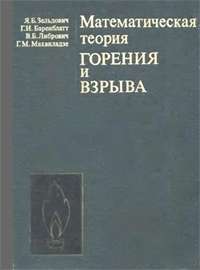
 Zeldovich – Mathematical Theory of Combustion and Explosion
Zeldovich’s monograph, “The Mathematical Theory of Combustion and Explosion,” presents a unified approach to the mathematical and physicochemical foundations of modern combustion and explosion theory. It summarizes theoretical research on thermal and chain explosions, ignition theory, initiation of chemical transformation waves, laminar flame propagation, critical combustion phenomena (stability, propagation limits, transitions from one combustion regime to another), diffusion combustion of unmixed gases, and other aspects of reacting gas mechanics.
Combustion—a natural phenomenon that has captivated our imaginations since childhood and forever—is undoubtedly one of the most important physical and chemical processes in nature and human practice. The Greek myth of Prometheus, who stole fire from the gods and gave it to humans, and the cult of fire in other ancient homologies are a unique, poetic tribute to the role of fire in the emergence of civilization.
Scientific study of combustion began in the 18th century, along with the rapid development of chemistry. Initially, combustion was defined as the combination of combustible substances (primarily those containing hydrogen and carbon) with oxygen. Generalizing this view, chemists formulated the then-famous saying: “Life is a slow combustion.” This statement remains true today, as it is the combination of accumulated plant fuel with oxygen that serves as the source of energy for humans and living beings in general.
The elucidation of the chemical nature of combustion at this early stage of scientific development paved the way for the development of energetics and thermodynamics, as combustion is the primary source of high-temperature gases and energy. At the end of the 19th century, important studies of chemico-thermodynamic equilibria in the H2-H2O-CO-CO2-C-O2 system were intensively developed. These equilibria determine, to a first approximation, the temperature reached during the combustion of hydrocarbon fuels and the composition of the combustion products of gases, solids, and liquids.
The study of combustion and explosions, which began in the late 19th century and continues to the present, was associated with the advent of internal combustion engines, the development of internal ballistics in artillery and explosives, and, in recent decades, the widespread introduction of jet engines into technology. This largely stimulated the rapid development of combustion science.
In the early stages of combustion theory’s development, we note the names of V. A. Michelson (Russia, USSR), M. Berthelot, P. Vieille, E. Jouguet, Taffanel (France), P. Daniell, and D. L. Chapman (England).
In modern combustion research, the rate of chemical transformation is the focus. Today, combustion and explosion are defined as the rapid course of a reaction in a substance that is initially inert. The release of heat and/or active sites during the reaction itself is crucial. In modern usage, concepts such as combustion, explosion, flame, detonation, etc. are associated with the nature of the reaction, not its chemical content: for example, we speak of the flame of ozone decomposition (2O3 -> 3O2), although oxygen is released rather than consumed in this reaction. Of course, a complete understanding of the nature of a reaction can only be achieved with knowledge of its elementary events, mechanism, and kinetics, including combustion and detonation fronts. The book’s coverage is limited to slow combustion propagation, where gas compressibility can be ignored.
Heat and mass transfer theory is used only to the extent necessary for understanding combustion theory. D. A. Frapk-Kamenetsky’s well-known monograph, “Diffusion and Heat Transfer in Chemical Kinetics” (Moscow: Nauka, 1967, 2nd edition), exemplifying a concise and extremely clear presentation of the material, can serve as the reader’s primary source of guidance on this topic.
The authors also barely touch on the specific issues of solid fuel combustion, although the general methods discussed in the book are applicable to this case as well. These issues were the subject of recent monographs by Ya. B. Zeldovich, O. I. Leipunsky, and V. B. Librovich, “The Theory of Unsteady Combustion of Gunpowder” (Moscow: Nauka, 1975) and B. V. Novozhilov, “Unsteady Combustion of Solid Rocket Propellants” (Moscow: Nauka, 1973).
For other reasons, this book does not include issues of turbulent combustion of gases. Turbulent combustion theory is currently in its infancy; its core theoretical research has not yet been fully formulated, and therefore, including it in this book seems premature.
It should be noted that the “explosion” mentioned in the title of Zeldovich’s book, “Mathematical Theory of Combustion and Explosion,” is a thermal or chain explosion, i.e., a change in the chemical reaction regime. External, mechanical effects accompanying the release of energy are not considered.
In conclusion, we note that the first chapter of this book plays a special role. It briefly outlines the fundamental physical ideas and results that underlie combustion theory and are more fully mathematically reflected in subsequent chapters.
Combustion science is currently on the threshold of a new era, driven by both the relevance and the enormous advances in experimental methods (lasers!) and computational capabilities. We hope that the ideas and methods presented in this book will retain their relevance.
Download – Zeldovich – Mathematical Theory of Combustion and Explosion >>